
Could a single paragraph in your latest service agreement actually hand over the keys to your family home if a project goes sideways? It’s a heavy thought, and we understand the deep-seated anxiety that comes with signing documents you don’t fully understand. Most Australian business owners feel that same prickle of worry when they encounter dense legal jargon that seems designed to shift every ounce of risk onto their shoulders. You want to grow your business, not gamble your personal assets on a poorly worded contract.
In this guide, we’ll demystify exactly what is an indemnity clause so you can sign your next agreement with genuine peace of mind. We’re going to break down these complex promises to “make whole” and explain how they interact with your business insurance. You’ll learn how to identify hidden financial liabilities, understand the latest Australian protections against unfair contract terms, and discover the methodical steps we take to help you shield your hard-earned success from contractual oversights. We’ve seen how these clauses play out in the real world, and we’re here to ensure you have the clarity you need to protect your future.
Key Takeaways
- Understand what is an indemnity clause by stripping away the legal jargon to see how it functions as a promise to return a party to their original financial position.
- Grasp the critical distinction between an indemnity and a guarantee to ensure you aren’t unknowingly taking on more risk than your business can handle.
- Learn to distinguish between the legal obligations you sign in a contract and the actual insurance funding available to back those promises.
- Identify the significant dangers of signing “unlimited indemnity” agreements that could leave your personal assets exposed if they exceed your policy limits.
- Discover why automated insurance tools often miss the fine print and how a consultative, deep-dive approach ensures your coverage is truly fit for purpose.
What is an Indemnity Clause in the Australian Business Context?
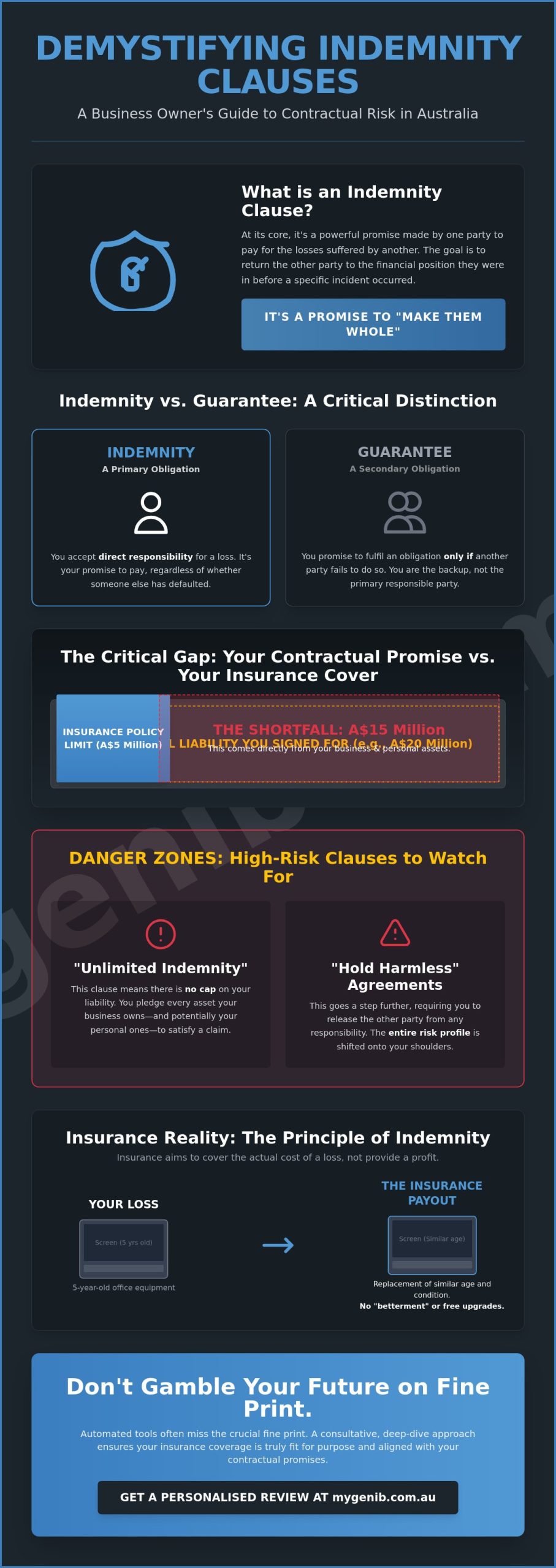
At its heart, an indemnity clause is a promise made by one party to pay for the potential losses or damages suffered by another. In the Australian commercial world, to “indemnify” someone means you’re committing to return them to the financial position they were in before a specific loss occurred; essentially, you’re “making them whole.” While it sounds like a simple handshake agreement, Indemnity is a powerful legal mechanism that shifts the financial burden of a mistake from the victim to the party responsible. We often see these clauses used to provide a sense of security in high-stakes deals where the risk of loss is real and potentially expensive.
To better understand how this legal promise works in practice, watch this helpful video:
You might wonder how this differs from a guarantee. Think of a guarantee as a promise to fulfil someone else’s obligation if they fail to do so, like a parent co-signing a car loan. An indemnity is different; it’s a primary obligation where you accept direct responsibility for a loss, regardless of whether someone else has defaulted. These clauses are now a standard fixture in almost every Australian commercial agreement, from office leases to software service contracts. Ultimately, an indemnity clause acts as a financial safety net that ensures a professional error doesn’t lead to a total business collapse.
Common Scenarios Where Indemnity Arises
If you’re a consultant or contractor, you’ve likely seen these clauses in service agreements. Clients often ask for indemnity to protect themselves against any errors in the professional advice you provide. In lease agreements, property owners use them to ensure they aren’t held liable for injuries or damage that occur on the premises while you’re the tenant. For many consultants, these clauses are the primary reason they seek professional indemnity insurance, as they shield personal assets from the fallout of a professional slip-up during a project. It’s also worth noting that professional indemnity insurance requirements Australia regulatory bodies impose often set the minimum threshold for coverage, meaning your contractual obligations may demand even higher limits than your association mandates.
The “Principle of Indemnity” in Insurance
In the world of insurance, indemnity is designed to cover the actual cost of a loss, not to provide you with a profit. This leads to the concept of “betterment.” If your five-year-old office equipment is destroyed, insurance doesn’t typically pay for a brand-new, top-of-the-line upgrade. Instead, it aims to replace what you had with something of similar age and condition. This keeps the system fair and ensures that insurance remains a tool for protection rather than a way to gain an advantage after a disaster.
Contractual Clauses vs. Insurance Coverage: Bridging the Gap
Signing a contract is a significant milestone, yet it often comes with a hidden weight. You might understand the broad strokes of what is an indemnity clause, but there’s a vital distinction many overlook: the difference between your legal promise and your ability to pay for it. A contractual indemnity is your personal or corporate promise to cover a loss. Your insurance policy, however, is the funding mechanism designed to back that promise. If the wording in your contract exceeds the scope of your policy, you’re essentially standing alone in a financial storm.
One of the most dangerous phrases you’ll encounter is “unlimited indemnity.” When you sign this, you’re pledging every asset your business owns to satisfy a claim. If a project results in a A$20 million loss and your policy limit is only A$5 million, your business is responsible for the A$15 million shortfall. We also see “hold harmless” agreements frequently in Australian commercial contexts. These go a step further by requiring you to not only pay for the loss but also to release the other party from any legal responsibility, effectively shifting the entire risk profile onto your shoulders.
The nature of what you provide also changes your risk. For instance, product liability insurance handles indemnity differently for physical goods compared to professional advice. While one covers injury or damage caused by a tangible item, the other protects against the financial fallout of a professional error. Ensuring these align with your specific contract requires a steady, experienced hand to spot the gaps before they become liabilities.
Why Your Contract Wording Matters
We always look for “proportionate liability” in your agreements. This ensures you only pay for the portion of the loss you actually caused, rather than being held responsible for someone else’s negligence. Without this, you might find yourself caught by “contractual liability” exclusions. These occur when an insurer refuses to cover a loss because you’ve promised more in your contract than what common law would typically require of you. It’s a stressful discovery that usually only happens when a claim is already underway.
Matching Your Coverage to Your Obligations
A “one size fits all” approach to insurance is a gamble that rarely pays off. Your limits of liability must be measured against your largest potential exposure. If you’re managing a A$10 million contract but your policy is capped at A$2 million, you’re carrying a A$8 million risk on your own balance sheet. We believe in looking beneath the surface of your agreements to ensure your protection is truly fit for purpose. If you’re feeling uncertain about the fine print in your latest agreement, it might be time to speak with an expert broker who can help align your coverage with your contractual reality.
Navigating Contractual Risk with a Personalised Consultative Approach
While technology has made many parts of business faster, it hasn’t necessarily made them safer. Automated quote engines are built for speed, not for the meticulous detail required to truly understand what is an indemnity clause in the context of your specific project. These platforms can’t read the fine print of a complex service agreement or identify the subtle ways a client might be shifting disproportionate risk onto your shoulders. They offer a generic solution to a deeply personal problem, which often leaves business owners with a false sense of security.
We believe your protection deserves a more thorough investigation. A seasoned business insurance expert acts as a protective mentor, navigating the complexities of indemnity so you can focus on your work with total clarity. This consultative approach ensures your coverage isn’t just a certificate of currency but a robust shield that matches your actual contractual obligations. Having a dedicated expert who understands the nuances of the Australian market provides the long-term security needed to grow your business without the constant fear of hidden liabilities.
The MyGen Insurance Brokers Difference: Beyond “Tick and Flick”
Our manual risk assessment stands in stark contrast to the detached, cold nature of corporate automated platforms. We take the time to deep-dive into your industry, ensuring we understand every nuance of the Australian insurance market as it applies to your specific trade. This personalised method replaces the “tick and flick” culture with a diligent process that provides the calm and certain outcome every business owner deserves. It’s a transition from confusion to clarity that only comes from looking beneath the surface of your agreements.
Steps to Take Before Signing Your Next Agreement
Before you put pen to paper on your next agreement, we recommend following these methodical steps to protect your assets:
- Step 1: Identify the indemnity clauses. Scan the document for language that mentions “making whole,” “compensation,” or “reimbursement” for losses.
- Step 2: Consult your insurance broker. Share the draft contract with us so we can verify if your current policy actually funds the promises you’re about to make.
- Step 3: Align your policy limits. Ensure your coverage matches the maximum potential liability of the contract, rather than just an arbitrary industry minimum.
Maintaining professional confidence isn’t about avoiding all risk; it’s about managing it with diligence. By taking these steps, you ensure that your business remains a source of pride and stability rather than a source of anxiety. We’re here to do the heavy lifting, providing the seasoned expertise required to navigate the complexities of what is an indemnity clause so your future remains secure.
Signing Your Next Contract with Absolute Certainty
Understanding what is an indemnity clause is about more than just decoding legal definitions; it’s about safeguarding the legacy you’ve built with your own hands. We’ve explored how these promises function as vital financial safety nets and why your insurance policy must be the sturdy foundation that supports them. Relying on automated systems often leaves you exposed to hidden liabilities that only a meticulous, human-led review can uncover. True protection comes from looking beneath the surface of every agreement before you commit your business to it.
At MyGen, we bring over 20 years of industry experience and deep expertise in Professional Indemnity to every partnership. We don’t just skim the surface; we take a personalised, consultative approach to ensure your coverage is perfectly suited to your specific industry risks. Let MyGen deep-dive into your risks and find the right indemnity protection for you.
You deserve the peace of mind that comes from knowing your personal assets are protected from contractual oversights. With a steady hand to guide you through these legal complexities, you can return your focus to what matters most: growing a successful and resilient Australian business. We’re here to ensure you move forward with genuine confidence.
Frequently Asked Questions
What is an indemnity clause in a standard Australian contract?
An indemnity clause is a legally binding promise where one party agrees to compensate another for specific losses, damages, or liabilities. In a standard Australian commercial agreement, it acts as a risk-shifting mechanism that ensures if a mistake occurs, the party responsible pays to return the other party to their original financial position. Understanding what is an indemnity clause is essential because it defines the boundaries of your financial responsibility if a project doesn’t go to plan.
Is an indemnity clause the same as insurance coverage?
No, an indemnity clause is the legal obligation you accept in a contract, while insurance is the financial tool designed to fund that obligation. While the clause creates the legal debt, your Professional Indemnity Insurance provides the capital to pay it. Without the right insurance in place, you remain legally bound by the clause but must settle any claims using your own business or personal assets.
Can I limit my liability in an indemnity agreement?
You can certainly negotiate to limit your liability by including financial caps or by narrowing the scope of the indemnity to specific events. We often recommend seeking “proportionate liability” wording, which ensures you’re only responsible for the portion of the loss you actually caused. This prevents you from being held financially accountable for the negligence of third parties or the client themselves, providing a more balanced risk profile.
What happens if I sign an indemnity clause that my insurance doesn’t cover?
If you sign a clause that falls outside your policy’s scope, your business becomes personally liable for the full cost of any resulting claim. Insurers often include “contractual liability” exclusions for promises that go beyond your standard duties under common law. This gap in protection can lead to severe financial distress, as you’ll be forced to fund legal fees and settlements without any support from your insurer.
Why do consultants specifically need professional indemnity insurance?
Consultants require this protection because their primary output is expert advice, which carries an inherent risk of professional error or omission. If a client suffers a financial loss due to a recommendation you made, they’ll likely trigger the indemnity clause in your contract to recover those funds. Professional Indemnity Insurance is designed to cover these advice-based risks, shielding your personal assets from the high costs of litigation and damages.
How much does professional indemnity insurance cost for a small business in Australia?
The cost of Professional Indemnity Insurance varies based on your specific industry, your annual turnover, and the level of risk associated with your professional activities. Other factors, such as the size of the contracts you sign and your previous claims history, also influence the final premium. Because every Australian business has a unique risk profile, we suggest a personalised consultation to determine a suitable level of protection that fits your specific needs and budget.