
What if your trailer is insured, but the tools it carries are treated differently? It’s understandable to wonder whether both belong under one policy or whether your business insurance reflects how each asset is used, stored and moved. Insurance for trailers and equipment needs a closer look than the policy label alone can provide.
This guide explains the insurance categories that may be relevant, including business property, tools of trade and equipment, theft, commercial motor and marine transit cover. It also outlines the information to gather for a useful review, so you can describe your trailer, equipment and day-to-day work clearly.
MyGen Insurance Brokers provides personalised business insurance reviews, drawing on 20+ years of industry experience and supporting clients through the policy period and claims process. All services are subject to the company’s terms and conditions, viewable on this site.
Key Takeaways
- Insurance for trailers and equipment is a risk-review question, not one universal policy label. Consider the trailer, its contents and other business assets separately.
- Build a clearer picture of your risks by recording what you own, how each asset is used, and where it is stored or moved.
- Review relevant options, such as business property, tools and equipment, theft, commercial motor and marine transit cover, alongside the policy wording.
- MyGen can review your business risks and potential blind spots to help shape a considered insurance package.
Insurance for trailers and equipment: understand the business risks
It can be difficult to know where a work trailer ends and its contents begin in an insurance review. The trailer, tools carried inside it, equipment used on site and goods being transported each raise different questions. A policy label alone does not explain how each item or business activity is treated.
Think of insurance for trailers and equipment as a risk-review question, rather than one universal policy or guaranteed package. How cover applies depends on the policy wording, the property insured and the use described to the insurer. Understanding insurance fundamentals can help you make sense of how policies set out their terms.
A video example of trailer insurance in practice:
How do trailer cover and tools of trade fit into business insurance?
Start by separating the assets and the risks. The trailer is distinct from the tools and equipment it carries. Goods being transported are another consideration, while the trailer’s business use may raise motor-related questions. Assets may also move between locations or be used at worksites, so describe those activities clearly as part of a review.
Relevant categories to consider include General Property (Tools of Trade & Equipment), Commercial Motor and Marine Transit Insurance. These are areas for review, not a promise that a particular asset, event or journey is covered. MyGen’s complete business insurance guide provides broader context for considering business risks together. MyGen provides personalised business insurance reviews to help bring those risks into focus.
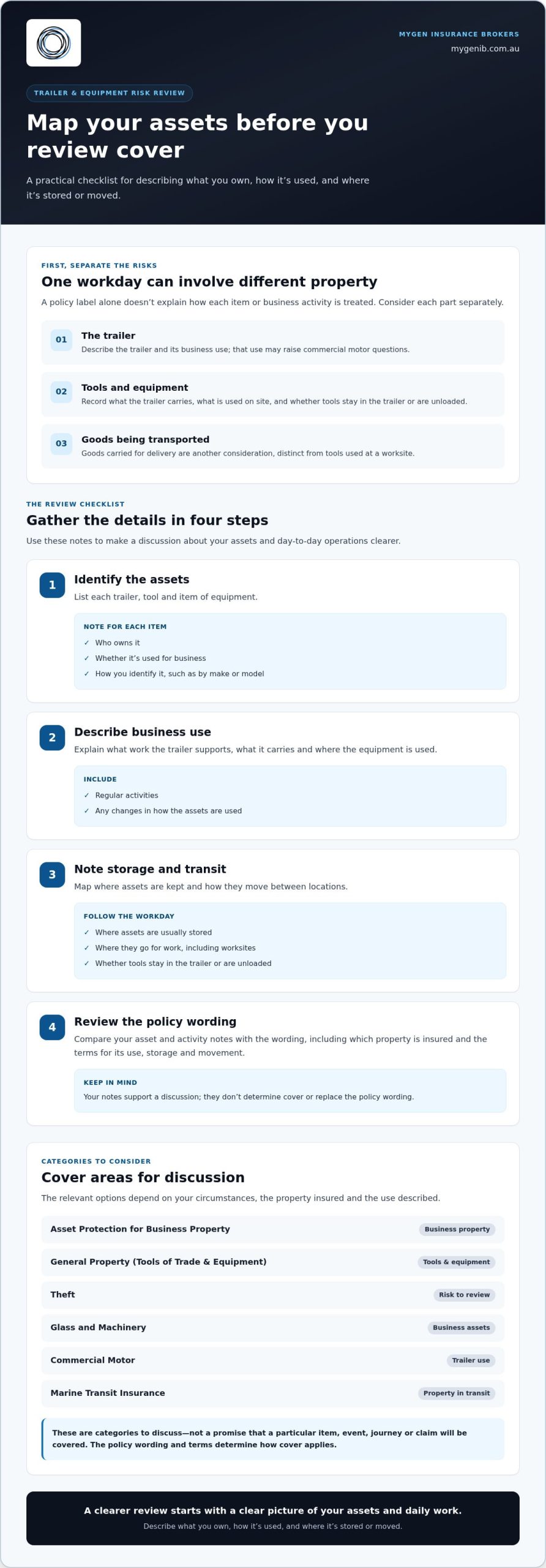
How to review insurance for trailers and equipment before choosing cover
A clear picture of your assets and daily operations makes a business insurance review more useful. Use this checklist to organise the details for discussion. It won’t determine cover or replace the policy wording.
- Identify the assets. List each trailer, tool and item of equipment. Note who owns it, whether it’s used for business and how you identify it, such as by make or model.
- Describe business use. Explain what work the trailer supports, what it carries and where the equipment is used. Include regular activities and any changes in use.
- Note storage and transit. Record where assets are usually kept, where they go for work and how they move between locations. Note whether tools stay in the trailer or are unloaded at a worksite.
- Review the wording. Compare your asset and activity notes with the policy wording. Look at which property is insured and the terms that apply to its use, storage and movement.
For more context on vehicle-related considerations, read MyGen’s commercial vehicle insurance guidance as you prepare for a broader review.
What details help clarify your trailer and equipment risks?
Picture a typical workday: what’s loaded before departure, where the trailer travels, whether equipment is used at several sites, and where everything is stored afterwards. An inventory of relevant business property helps bring these details together. For example, tools used at a worksite have different circumstances from goods carried for delivery. Describe each use, including where equipment is kept between jobs, to help identify the right questions for a review.
These notes support a discussion, but the policy wording explains how cover applies. A personalised business insurance review can help bring trailer, tools and equipment risks into focus.
Arrange a considered business insurance review for trailers and equipment
Once you’ve mapped your assets and how they’re used, consider how those risks fit together. MyGen Insurance Brokers reviews your business activities and existing arrangements to identify potential gaps across trailers, tools and other business property, then designs and sources a tailored business insurance package for consideration.
Depending on your circumstances, the review may consider Asset Protection for Business Property, General Property (Tools of Trade & Equipment), Theft, Glass and Machinery, as well as Commercial Motor and Marine Transit Insurance. These are categories to discuss, not a promise that a particular item, event or claim will be covered. The policy wording and terms determine how cover applies.
What to expect from MyGen’s broker-led review
MyGen takes the time to understand how your business operates and explain relevant considerations in clear, practical terms. With 20+ years of industry experience, the team provides ongoing support throughout the policy period and assistance through the claims process, helping you understand the next steps as circumstances change.
MyGen is a member of the National Insurance Brokers Association (NIBA) and subscribes to the NIBA Code of Practice (the Code). Alongside this commitment, its personalised approach considers how your trailer, equipment and business activities relate to the wider risk picture.
All services are subject to the company’s terms and conditions, viewable on the site.
Keep your protection aligned with your business
Your assets and the way you use them can change as your work develops. Include insurance in that review, so new equipment, a change in trailer use or different storage arrangements can be considered before they become blind spots.
A personalised review can help bring those changes into focus. MyGen draws on 20+ years of industry experience, provides policy-period support and claims assistance, and subscribes to the NIBA Code of Practice (the Code) as a member of the National Insurance Brokers Association (NIBA). All services are subject to the company’s terms and conditions, viewable on the site.
Frequently Asked Questions
Is insurance for a work trailer separate from insurance for the equipment it carries?
Not necessarily, but the trailer and its contents may be considered under different parts of a business insurance arrangement. For example, the trailer may raise motor-related questions, while tools could be considered under a property or tools-of-trade category. For insurance for trailers and equipment, review the policy schedule and wording to see which property is insured and how each item is treated.
Can business insurance cover tools and equipment used away from business premises?
That depends on the policy wording and the circumstances described for the business. Tools taken from a workshop to a customer’s site, for instance, have a different use pattern from equipment that stays at one location. MyGen can review relevant options, such as General Property (Tools of Trade & Equipment), and explain how the policy terms relate to those activities.
What should I tell an insurance broker about my trailer and equipment?
Explain who owns each asset, what work it supports, what you carry in the trailer and where the equipment is used. Include usual storage arrangements and how assets move between sites. Mention changes in activity, such as taking on delivery work or using a trailer for a new purpose. These details help shape a more complete risk review, though they do not determine cover by themselves.
Does commercial motor insurance automatically cover tools carried in a trailer?
No, don’t assume that commercial motor insurance automatically covers tools inside a trailer. The policy may address motor-related risks, while tools and equipment may be considered under separate property cover. Review the insured property and relevant wording rather than relying on the policy name alone.
For a considered review of insurance for trailers and equipment, contact MyGen to discuss your business insurance needs.