
What if the insurance policy you rely on to protect your restaurant is actually designed to stay silent when you need it most? You’ve likely spent hours squinting at dense Product Disclosure Statements, only to feel that these automated, generic policies don’t truly understand the heat of your kitchen or the specific risks of your front-of-house team. It’s a common frustration in our industry. You want to focus on your guests, yet the fear of a rejected claim during a crisis remains a heavy weight on your shoulders.
We’re here to help you find clarity and pull back the curtain on the critical exclusions within business insurance for hospitality industry australia for 2026. This guide will show you how to identify the hidden gaps in your coverage, from navigating evolving regulatory changes and rising operational costs across the sector to managing new biosecurity and public health risks. By the end of this article, you’ll have a clear roadmap to move from policy confusion to absolute confidence, ensuring your cafe, bar, or restaurant is protected by more than just a standard template.
Key Takeaways
- Understand why specific exclusions are built into your policy to keep premiums manageable while still protecting your venue from catastrophic losses.
- Learn to distinguish between sudden, accidental damage and standard wear and tear so you can manage your kitchen maintenance and insurance claims effectively.
- Discover how the right business insurance for hospitality industry australia can be tailored to cover gaps that generic, automated policies often overlook.
- Identify the universal exclusions around staff negligence and intentional acts to better protect your restaurant or bar from internal risks.
- Explore the vital role of a specialist broker in negotiating “write-backs” to restore essential coverage that is typically removed in standard contracts.
Understanding Hospitality Insurance Exclusions in the Australian Market
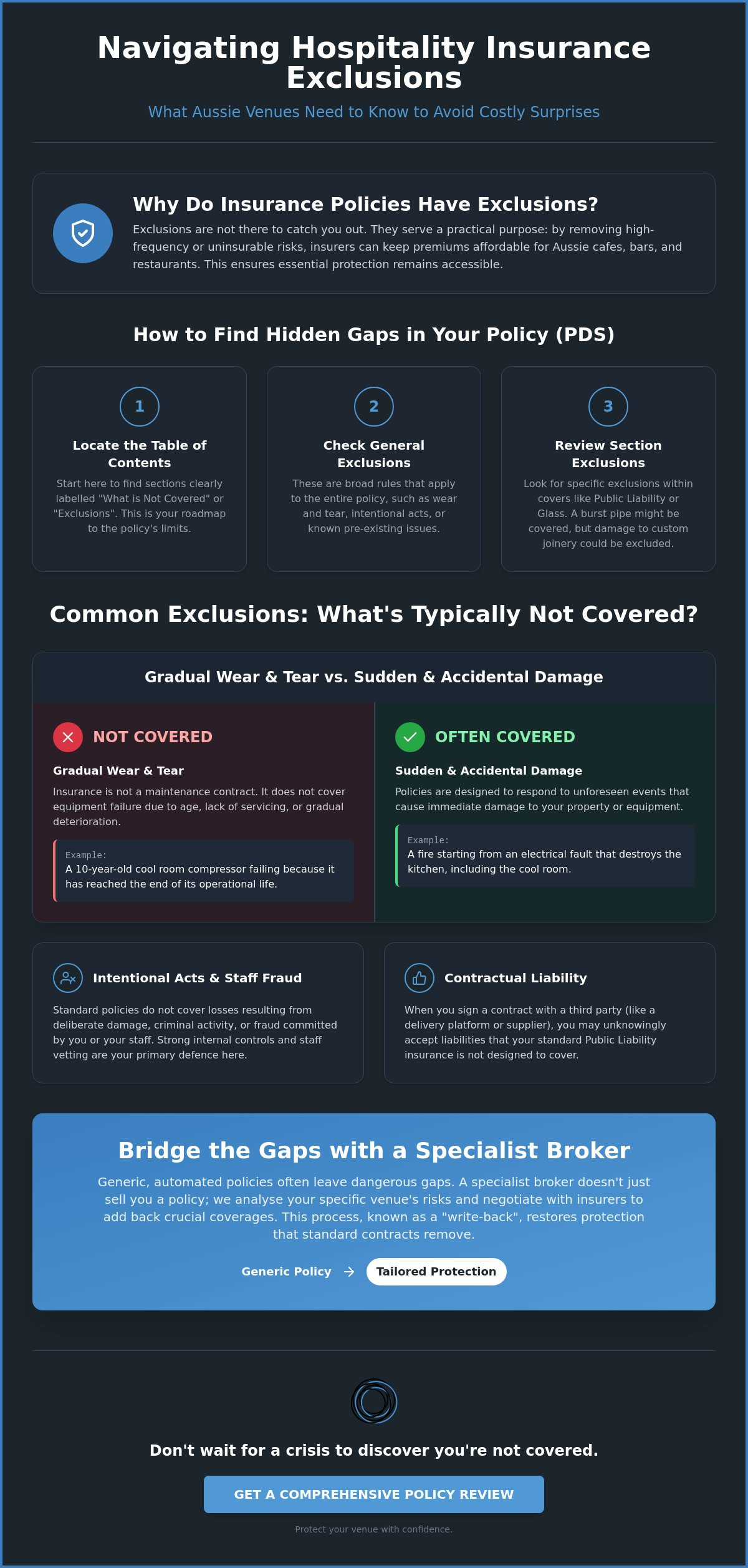
In the Australian hospitality sector, an insurance exclusion is a specific provision within your policy that removes coverage for certain hazards. While it might feel like a “gotcha” moment when a claim is denied, these boundaries actually serve a practical purpose. By removing high-frequency, uninsurable risks, insurers can keep premiums manageable for small cafes and family-run restaurants. Without these limits, the cost of business insurance for hospitality industry australia would likely be out of reach for many local operators.
Understanding how Insurance in Australia is regulated helps clarify why the Product Disclosure Statement (PDS) is so vital. This document isn’t just paperwork; it’s a legal requirement that outlines exactly where your protection starts and ends. You also have a “Duty of Disclosure,” which means you must tell your insurer about any risks that could affect their decision to cover you. If you forget to mention a new deep fryer or a change in late-night trading hours, you might accidentally create an unintentional exclusion that leaves you exposed during a crisis.
To better understand how these concepts apply in a similar high-stakes environment, watch this helpful video:
Why ‘Standard’ Hospitality Policies Have Non-Standard Gaps
Many operators opt for automated, “tick and flick” policies, but these often come with generic gaps. A standard policy might exclude industry-specific risks like food spoilage or liquor liability by default, which is why choosing the right business insurance for hospitality industry australia requires more than a basic online search. There is a significant difference between a general exclusion and a specific policy endorsement tailored to your unique hospitality fit-out. We’ve seen venues assume they’re covered for a burst pipe, only to find the PDS excludes damage to custom timber joinery.
How to Identify Exclusions in Your PDS
Identifying these gaps doesn’t have to be a headache. You can find the truth in your PDS by following these three steps:
- Locate the Table of Contents: Look for headings titled “What is Not Covered” or “Exclusions.”
- Check General Exclusions: These are broad items like wear and tear or intentional acts that apply to the whole policy.
- Review Section Exclusions: These apply specifically to certain covers, such as Public Liability or Glass.
The “Exclusions” section acts as the definitive boundary of your venue’s financial protection, marking the line where the insurer’s responsibility ends and yours begins.
The Most Common Exclusions in Hospitality Policy Types
Identifying the boundaries of your coverage is essential for long-term security. While we strive to protect every corner of your venue, certain risks are universally excluded from business insurance for hospitality industry australia. For instance, intentional acts or fraud committed by staff members are not covered. If a team member intentionally damages property or engages in criminal activity, the resulting financial loss falls outside the scope of standard protection. This is why thorough background checks and a culture of integrity remain your first line of defence.
A common point of confusion involves the difference between sudden damage and general wear and tear. Insurance is designed to respond to the unexpected, such as a fire or a burst pipe, rather than acting as a maintenance contract for your kitchen’s cool room or ovens. If a compressor fails simply because it’s ten years old and hasn’t been serviced, the claim will likely be rejected. Referencing the Australian government guide to business insurance can help you understand the fundamental purpose of these policies.
Contractual liability is another area where many Australian venue owners unknowingly trip up. When you sign a contract with a third-party delivery platform, you may be assuming liabilities that your public liability insurance is not equipped to handle. Similarly, under professional indemnity insurance, you cannot cover “known circumstances”. This means if you’re already aware of a potential dispute or error before taking out the policy, that specific issue will be excluded. It’s always best to speak with an expert before signing new commercial agreements.
Hospitality Gaps: Cyber and Professional Advice
In 2026, digital risks are more prominent than ever. Many hospitality managers provide consulting advice or manage complex booking systems, yet “advice given without a fee” is often a standard exclusion. Cyber-related losses from digital booking systems are also frequently excluded from general property policies. Without a specific cyber rider, a data breach involving guest information could leave your business financially vulnerable.
Commercial Motor and Property Gaps for Venues
If your cafe or restaurant uses vehicles for catering or deliveries, finding the right business insurance for hospitality industry australia means watching for commercial vehicle insurance exclusions like “unlicensed drivers” or “unsecured loads”. These are immediate deal-breakers for insurers. Many owners are also surprised by “property in physical or legal control” exclusions. This often arises during a fit-out when you’re technically responsible for equipment that isn’t yet officially part of your building’s permanent structure.
Bridging the Hospitality Coverage Gap with a Consultative Broker
Selecting the right business insurance for hospitality industry australia is rarely as simple as clicking a button on a comparison website. While digital platforms offer speed, they often lack the depth required to protect a complex venue. At MyGen Insurance Brokers, we move beyond the “tick and flick” model by conducting a thorough deep-dive into your specific operations. We look for the hidden risks that automated systems miss, such as the 55% year-on-year increase in cybercrime costs that now sees average incidents for medium businesses approaching $100,000. Our goal is to ensure your policy reflects the reality of your kitchen, your staff, and your guests.
One of the most valuable roles we play is negotiating “write-backs” with insurers. These are specific agreements that add back coverage for risks typically excluded in standard contracts, such as food spoilage, certain liquor liability scenarios, or protection for hired event equipment from NextGen AV. When a crisis occurs, we act as your dedicated advocate. If an insurer attempts to cite a vague exclusion to deny a claim, we step in to provide the technical evidence and industry context needed to secure a fair outcome. This partnership turns a rigid legal document into a flexible safety net that actually works when you need it.
The Danger of Automated ‘Instant’ Quotes for Venues
It’s tempting to choose the cheapest policy available, but this often leads to a significant “suitability gap.” We’ve seen how expert insurance brokers provide more value than automated quotes by meticulously reading the fine print that most owners simply don’t have the time to digest. Given that foodborne illnesses cost the Australian economy an estimated A$3 billion annually, a generic policy with a poorly defined contamination exclusion could leave your business facing total financial ruin. A broker ensures your coverage is built for the 2026 regulatory environment, not just a lowest-common-denominator risk profile.
Next Steps: Reviewing Your Venue’s Risk Profile
As you approach your next renewal cycle, we encourage you to take a methodical look at your current protection. The hospitality landscape is shifting, with 52% of operators now citing rising supply costs as a major pressure, making every dollar spent on premiums more critical than ever. We can help you audit your existing documents to find where “standard” exclusions might be hiding. Never assume coverage exists just because a premium was paid; instead, let us help you verify that your venue is truly secure.
Protecting Your Passion with Precision
We understand that running a successful venue is about more than just great service; it’s about the community you’ve built and the years of hard work you’ve invested. Navigating the complexities of business insurance for hospitality industry australia requires a shift away from generic online templates and toward a deeper, more investigative understanding of your specific policy boundaries. By identifying common gaps like contractual liabilities or cyber exclusions today, you’re preventing the stress of a rejected claim when you’re at your most vulnerable.
Our team, led by Anthony Simpson with over 20 years of industry experience, acts as a protective mentor for your business. As a Corporate Authorised Representative of Community Broker Network, we specialise in the unique risk management needs of Australian hospitality operators. We don’t just skim the surface; we dive into the details to ensure your venue is truly secure against the evolving risks of 2026. Ready to move from confusion to absolute clarity? Book a personalised hospitality risk consultation with MyGen Insurance Brokers to review your current policy and bridge any hidden gaps. You’ve worked hard to create something special, and we’re here to help you keep it that way.
Frequently Asked Questions
Can I get a specific exclusion removed from my hospitality insurance policy?
You can often have specific exclusions removed or modified through what we call “write-backs” or tailored endorsements. While a standard online policy is rigid, a specialist broker can negotiate with underwriters to add back coverage for risks like food spoilage or specific machinery breakdown. This process ensures your business insurance for hospitality industry australia is a precise fit for your venue’s unique layout and equipment rather than a generic, off-the-shelf product.
What happens if my claim is rejected based on an exclusion I was not aware of?
If your claim is rejected due to an unknown exclusion, your first step is to request a formal explanation from the insurer’s internal dispute resolution team. If the outcome remains unsatisfactory, you can escalate the matter to the Australian Financial Complaints Authority (AFCA). Having a broker as your advocate is vital here. We investigate the PDS and the circumstances of the loss to challenge the insurer’s interpretation and fight for a fair settlement.
Are cyber attacks on my booking system always excluded from standard business insurance?
Most standard property and public liability policies in Australia exclude losses resulting from cyber attacks or data breaches. Given that self-reported cybercrime costs for medium-sized Australian businesses increased by 55% in 2026, relying on a general policy is a significant risk. You typically need a dedicated cyber insurance policy to cover the costs of recovering your booking system, notifying guests of a breach, and managing the subsequent reputational damage to your cafe or restaurant.
Does public liability insurance cover my own hospitality employees if they are injured?
No, public liability insurance is designed to protect you against claims from third parties, such as guests or delivery drivers, rather than your own staff. For employee injuries, you must rely on Workers’ Compensation, which is a mandatory requirement in every Australian state and territory. Understanding these boundaries is a key part of managing business insurance for hospitality industry australia, as it ensures you don’t leave your team or your finances unprotected during a workplace accident.