

Last month, a local business owner discovered that while their policy covered a customer slip, it wouldn't pay a cent for the A$50,000 in property damage caused by a sub-contractor. It’s a devastating situation many Australians face because they’ve relied on an automated, "tick and flick" policy without looking beneath the surface. We understand how frustrating it is to sift through jargon only to remain unsure about your actual protection. To truly secure your livelihood, you must understand what is not covered by public liability insurance before a crisis occurs. We believe you deserve more than a generic certificate; you need the peace of mind that comes from knowing exactly where your safety net ends. In this guide, we'll strip away the complexity to reveal critical gaps, from employee injuries to professional negligence. You'll gain a clear roadmap to identify your specific risks and the methodical steps needed to ensure your Australian business isn't left under-insured in 2026. Key Takeaways Learn why standard policies focus strictly on third-party damage and why your own business assets or employee injuries require separate, specialised protection. Gain a clear understanding of what is not covered by public liability insurance, specifically focusing on the "Care, Custody, and Control" limits that often leave trades and service businesses exposed. Discover how to navigate complex contractual liabilities and identify when your policy might fail to cover risks you've legally agreed to shoulder in commercial agreements. Understand the value of a deep-dive risk review to identify your unique "potholes" and learn how to close protection gaps with tailored add-ons like Cyber or Professional Indemnity insurance. Table of Contents Common Exclusions in Australian Public Liability Policies The Grey Areas: Where Small Businesses Often Feel Exposed Closing the Gaps with a Consultative Risk Review Common Exclusions in Australian Public Liability Policies Many Australian business owners feel a sense of relief once they've secured a policy, yet the reality is that public liability isn't a catch-all safety net. It's built to protect you against claims for third-party injury or property damage, but it won't reimburse you for your own business losses, stock damage, or equipment theft. Understanding what is not covered by public liability insurance is the first step toward genuine security. For instance, injuries to your staff are strictly excluded because they fall under mandatory state-based WorkCover or Workers Compensation schemes. Similarly, damage to property you own, lease, or occupy requires a separate property or business assets policy. Even motor vehicle accidents, which are a daily risk for many, are typically handled by Compulsory Third Party (CTP) or specialised commercial motor insurance rather than your general Liability insurance cover. To better understand this concept, watch this helpful video: The Advice and Professional … [Read more...] about What is Not Covered by Public Liability Insurance? Australian Guide 2026

Public Liability Insurance for Contractors: 2026 Guide
The cheapest public liability policy on the market is often the most expensive mistake an Australian contractor can make. We understand the frustration of jumping through hoops just to get on-site, only to find that securing the right public liability insurance for contractors Australia has become a complex moving target. You've likely felt the pressure to just "tick and flick" a generic form to keep the work flowing. It's a heavy burden when a simple oversight can leave your personal assets exposed. This 2026 guide will show you how to secure coverage that actually stands up when a claim hits, moving beyond automated quotes to provide genuine security. We'll explore the latest state-specific mandates, the truth about current premium trends, and how a consultative risk assessment protects your livelihood better than any algorithm. You'll discover how to align your coverage with the specific risks of your trade to ensure you're protected for the long term. Key Takeaways Understand why Australian contractors face unique liability exposures compared to employees and how to identify your specific site-based risks. Learn how to navigate complex commercial contracts to ensure your public liability insurance for contractors Australia meets every site entry requirement without leaving your assets exposed. Discover why automated "tick and flick" policies often fail during a claim and how a manual risk assessment identifies critical gaps in your protection. Identify "hidden" risks such as high-depth excavation or work in restricted zones that generic automated quotes frequently overlook. Table of Contents Understanding Public Liability: Why Australian Contractors Face Unique Risks Determining Your Coverage: Limits, Costs, and Contractual Requirements Navigating the Market: Why Personalised Brokerage Beats Automated Quotes Understanding Public Liability: Why Australian Contractors Face Unique Risks In Australia, your duty of care isn't just a suggestion; it's a legal obligation that follows you onto every job site. Understanding Public Liability is about recognising that you are legally responsible for any third-party injury or property damage caused by your business activities, which is why securing public liability insurance for contractors Australia is a fundamental requirement. Unlike employees who are often shielded by an employer's policy, you carry the weight of vicarious liability for your own actions and those of your subcontractors. This exposure makes your choice of coverage a critical pillar of your business structure. To better understand this concept, watch this helpful video: A single mistake can lead to catastrophic financial consequences that reach far beyond your business bank account. Beyond the settlement itself, the legal defence costs alone can bankrupt a small business before a case even reaches a courtroom. We've seen how a steady hand in choosing public liability insurance for contractors Australia provides the peace … [Read more...] about Public Liability Insurance for Contractors: 2026 Guide

Public Liability Insurance for Market Stalls
The "tick and flick" insurance quote you bought in five minutes might be the most expensive mistake your market business ever makes. We know the pressure of an upcoming market day, where the stress of organising stock and managing council paperwork often leads to choosing the quickest insurance option available. It's tempting to grab the first policy you find, but securing public liability insurance for market stalls involves more than just meeting a permit requirement. It's about ensuring your livelihood is protected when things go wrong. In this guide, we'll explain why a professional risk assessment provides a far sturdier shield than an automated system, especially when you're caught between $10M and $20M cover requirements. We'll explore how to protect yourself from product defect claims and the most efficient way to get your Certificate of Currency into the hands of organisers so you can trade with peace of mind. Key Takeaways Understand why public liability insurance for market stalls requires a tailored approach to ensure you're genuinely protected against third-party injuries and property damage. Learn why $20 million is becoming the required standard for many Australian organisers and how your specific products influence your premium. Discover the pitfalls of "tick and flick" automated systems and how a broker's investigation identifies gaps that generic policies often miss. Prepare for your next event by documenting high-risk activities like food handling or selling children's toys to streamline the underwriting process. Table of Contents What is Public Liability Insurance for Market Stalls? Choosing the Right Level of Cover: Million vs Million How to Organise Your Market Stall Insurance What is Public Liability Insurance for Market Stalls? Public liability is your financial safety net. It protects you against the significant costs associated with being found liable for third-party injury or death. This protection extends to property damage, such as when a gust of wind sends your gazebo into the expensive stock of the stall next to yours. In an Australian market environment, your duty of care is the legal obligation to take reasonable steps to prevent foreseeable harm to anyone visiting or working near your stall. Because the risks in a crowded public space are high, most Australian market organisers and local councils make this cover mandatory before you can trade. Understanding What is Public Liability? is about more than just compliance; it's about protecting your livelihood. When you secure public liability insurance for market stalls, you're transferring the risk of expensive legal fees or compensation claims to an insurer. This allows you to focus on your customers while we ensure your protection is robust and reliable. The Crucial Link: Public vs Product Liability for Makers For artisans and food vendors, public liability is only half the story. While it covers a customer tripping over your gazebo leg, it won't … [Read more...] about Public Liability Insurance for Market Stalls

How Much Professional Indemnity Cover Do I Need? A 2026 Australian Guide
What if the "standard" $1 million limit you selected on a generic insurance site is actually the most dangerous number in your business plan? It's a question many Australian professionals are asking themselves as they face increasingly complex contracts and the rising cost of legal representation. You likely feel the frustration of trying to figure out how much professional indemnity cover do I need while being pushed toward "tick and flick" automated quotes that don't understand the nuances of your work. It's completely natural to worry that a major claim could outstrip your policy, leaving your hard-earned assets exposed. We believe you deserve more than a guess. In this 2026 guide, you'll discover the specific factors that determine your ideal professional indemnity limit and why a tailored approach beats a generic algorithm every time. We'll break down the latest regulatory requirements for your industry, explain how to calculate the potential impact of a project failure, and show you why having a professional broker in your corner provides the confidence that your legal defence costs are truly covered. By the end, you'll have a clear framework to move from uncertainty to total professional security. Key Takeaways Identify if your industry has statutory minimums, such as those set by AHPRA or the Tax Practitioners Board, to ensure you meet your essential legal obligations. Review your client contracts for specific mandates, as many Australian government and corporate tenders now require a minimum of $10 million or $20 million in cover. Calculate your ideal limit by assessing your largest project value and the potential financial "ripple effect" that a professional mistake could have on your client's business. Discover exactly how much professional indemnity cover do I need by moving away from generic automated quotes and toward a precision-based risk assessment. Gain peace of mind by ensuring your policy includes adequate provision for legal defence costs, which are essential for navigating complex Australian claims. Table of Contents Understanding the Foundations: Regulatory and Contractual Minimums Assessing Your Business Risk: How to Calculate Your Ideal Limit Why the Consultative Approach Beats an Automated Quote Understanding the Foundations: Regulatory and Contractual Minimums Determining how much professional indemnity cover do I need begins with looking at the floor rather than the ceiling. For many Australian businesses, the minimum level of protection isn't a choice; it's a legal requirement. Whether you are an accountant governed by the Tax Practitioners Board or a health practitioner registered with AHPRA, statutory minimums exist to protect the public. Professional liability insurance, as it is known globally, acts as a financial safety net that ensures your professional mistakes don't lead to personal ruin. It's a legal requirement for many, but it's also a foundational piece of your professional reputation. Current … [Read more...] about How Much Professional Indemnity Cover Do I Need? A 2026 Australian Guide

Management Liability Insurance Guide for Directors
Imagine receiving a formal notice from Fair Work or the ATO that doesn't just name your company, but lists you personally as a respondent. For many Australian directors, the realisation that their family home and personal savings could be on the line during a business dispute is a source of constant, quiet anxiety. You've spent years building your legacy, and it's only natural to feel protective of the assets you've worked so hard to accumulate. We understand that the distinction between your professional duties and your personal life can feel dangerously thin when regulatory pressure mounts, which is why it's vital to know what does management liability insurance cover before a crisis hits. This guide provides a clear roadmap for protecting your personal wealth, ring-fencing your private life from the unique risks found in our local regulatory environment. We'll break down the specific protections this cover provides and explain why a tailored policy offers far more security than a generic, automated quote. By the end of this article, you'll have the certainty you need to lead your business with confidence, knowing your personal future is secure. Key Takeaways Learn how to ring-fence your personal assets, such as your family home and savings, from the financial fallout of business-related lawsuits and regulatory investigations. Gain a comprehensive understanding of exactly what does management liability insurance cover, including the four distinct pillars of protection required to navigate the Australian corporate landscape. Understand why high-quality legal defence is your first line of protection and how a robust policy manages these rapidly escalating professional costs before they impact your bottom line. Discover the hidden dangers of relying on automated, generic insurance quotes that often overlook the nuanced risks specific to your industry and operational structure. Learn how to move from a state of regulatory anxiety to professional certainty by securing a policy that is meticulously tailored to your unique leadership role and responsibilities. Table of Contents Understanding Management Liability: The Shield for Your Personal Assets The Four Pillars: Exactly What Does Management Liability Insurance Cover? Why Small Businesses Can’t Rely on "Tick and Flick" Insurance Quotes Understanding Management Liability: The Shield for Your Personal Assets When business owners ask what does management liability insurance cover, the simplest answer is that it acts as a personal shield for your private assets. While most business insurance policies are designed to protect the entity's physical property or its public reputation, management liability is fundamentally different. It covers the costs of defending and settling claims that arise from "wrongful acts" committed while managing a company. This means that if a decision you make in the boardroom leads to a legal challenge, the policy steps in to manage the financial … [Read more...] about Management Liability Insurance Guide for Directors

Management Liability Insurance Cost in Australia: A 2026 Pricing Guide
What if the most expensive part of your management liability insurance isn't the premium itself, but the hidden exclusions that leave your personal assets exposed during a Fair Work investigation? Many Australian directors feel the weight of a litigious environment where "payday super" rules and heightened ASIC scrutiny make the boardroom feel like a high-stakes gamble. We understand that seeing your management liability insurance cost Australia climb can be frustrating, especially when it's unclear what that investment actually secures for your peace of mind. It's a common concern that we've helped many local businesses navigate by looking beneath the surface of generic, "tick and flick" quotes. You deserve a policy that acts as a steady, protective hand when regulatory pressure mounts. This guide will help you discover the specific factors driving premiums in 2026, from the new high-income threshold for unfair dismissal to the impact of your company's internal governance. We'll show you how to secure comprehensive protection that genuinely pays out, ensuring your board can lead with confidence rather than fear. Key Takeaways Understand how management liability acts as a multi-layered shield, safeguarding both your personal assets and the company's future from an increasingly litigious environment. Identify the primary drivers of your management liability insurance cost Australia, including how your industry classification and annual turnover influence insurer appetite. Learn how implementing robust HR procedures and conducting regular internal audits can significantly lower your risk profile and lead to more favourable premium pricing. Discover why a consultative, deep-dive approach identifies critical gaps that "tick and flick" online quotes often miss, especially regarding Fair Work investigations. Secure genuine peace of mind for your board by moving beyond generic coverage toward a policy tailored to your unique internal governance and financial health. Table of Contents Understanding Management Liability Insurance and Its Value in Australia What Influences Management Liability Insurance Costs in Australia? How to Minimise Your Management Liability Premium in 2026 Understanding Management Liability Insurance and Its Value in Australia Management liability acts as a sophisticated, multi-layered shield. It's a specialised form of Liability insurance that doesn't just look at the company as a whole; it protects the personal assets of the individuals making the tough decisions. While many directors assume their standard business insurance covers every internal mishap, the reality is often more complex. We've seen how a single oversight in the boardroom can lead to personal financial ruin without the right safeguards in place. Many people confuse Directors and Officers (D&O) insurance with a full management liability package. D&O is certainly the core, protecting against breaches of duty or negligence. However, a … [Read more...] about Management Liability Insurance Cost in Australia: A 2026 Pricing Guide

Public Liability vs Professional Indemnity Insurance Australia: What is the Difference?
If a client trips over a stray laptop cable in your office, you likely know which policy to call, but what happens if they "trip" over the professional advice you provided instead? It is a common point of friction for local business owners who find themselves staring at a screen of "tick and flick" options without a clear explanation of what they actually cover. Understanding the nuances of public liability vs professional indemnity insurance australia is not just about ticking a box for a contract; it is about building a layered strategy that protects both your physical presence and your hard-earned expertise. We understand the frustration of feeling under-insured or, conversely, paying for coverage that doesn't fit your daily reality. You want to focus on growing your business, not decoding insurance jargon or worrying about a potential lawsuit that could derail your progress. This article will clear the confusion between physical risks and professional errors to ensure your Australian business is properly protected. We will walk through the specific legal obligations for different industries and provide a simple way to distinguish between your physical and intellectual liabilities so you can move forward with confidence. Key Takeaways Distinguish between physical mishaps on your premises and the financial fallout of professional advice to ensure your liability strategy is sound. Identify whether your industry, such as healthcare or finance, has mandatory insurance obligations under Australian regulatory bodies like AHPRA or the TPB. Gain a clear, jargon-free understanding of public liability vs professional indemnity insurance australia so you can stop guessing and start protecting your business with precision. Uncover the "contractual requirement" trap and learn why reviewing your client agreements is vital before you commit to a specific level of cover. Discover why integrating both policies through a consultative broker simplifies your claims process and uncovers hidden risks that automated sites often miss. Table of Contents Defining the Divide: Physical Risks vs Professional Advice Choosing the Right Cover for Your Australian Business The Risk Management Approach: Why Integration Matters Defining the Divide: Physical Risks vs Professional Advice Understanding the difference between public liability vs professional indemnity insurance australia starts with a simple distinction: one covers what you do physically, while the other covers what you say professionally. In Australia, Public Liability protects your 'actions,' while Professional Indemnity protects your 'advice'. We often find that business owners feel a sense of unease when selecting cover, fearing they might leave a gap in their protection. By looking at the specific triggers for a claim, we can turn that confusion into a structured plan for security. The easiest way to remember the divide is the 'Slip and Trip' rule. If a visitor trips over your laptop bag in a … [Read more...] about Public Liability vs Professional Indemnity Insurance Australia: What is the Difference?
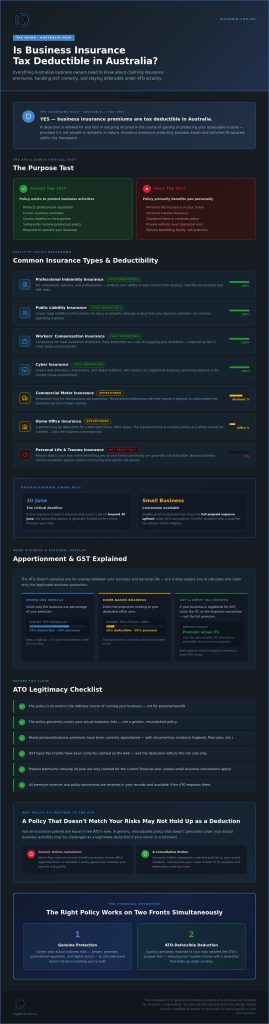
Is Business Insurance Tax Deductible? 2026 Guide
Your business insurance premium isn't just a cost of doing business. It's a legitimate tax deduction that could meaningfully reduce what you owe the ATO each financial year. So if you've been wondering whether business insurance is tax deductible in Australia, the short answer is yes, but the full picture is worth understanding properly before you lodge your return. If premiums feel heavier than they used to, you're not imagining it. Many Australian business owners are feeling the pressure of rising insurance costs in 2026, and the last thing you want is to overpay your tax bill on top of that. Add in the genuine confusion around GST, Input Tax Credits, and what the ATO actually expects to see if it comes knocking, and it's easy to see why so many people feel uncertain about what they can and can't claim. This guide cuts through that uncertainty. You'll discover exactly which business insurance premiums qualify as deductions, how to handle the GST correctly, and what makes a claim legitimate in the ATO's eyes. More than that, you'll see how the right policy, one that's genuinely matched to your specific risks, isn't just protection. It's a strategic asset working for your business on two fronts at once. Key Takeaways Understanding whether business insurance is tax deductible in Australia comes down to one core ATO principle: the premium must be incurred in the ordinary course of running your business, not for personal benefit. When your business and personal life overlap — such as with a home-based operation — you'll need to apportion your premiums correctly and understand how GST and Input Tax Credits affect what you can actually claim. Not all insurance policies are created equal in the ATO's eyes; a policy that doesn't genuinely cover your actual risks may not hold up as a legitimate business deduction if scrutinised. A consultative broker can uncover hidden exposures that generic online calculators routinely miss, ensuring your cover is both fit for purpose and defensible come tax time. Getting your insurance strategy right in 2026 means working smarter on two fronts at once — genuine protection for your business and a deduction that holds up under ATO scrutiny. Table of Contents The ATO Rules: Understanding Deductibility for Business Insurance Apportionment and GST: Navigating Complex Tax Scenarios Strategic Protection: Why Broker-Led Policies Maximise Value The ATO Rules: Understanding Deductibility for Business Insurance The foundation of any legitimate insurance deduction sits inside Section 8-1 of the Income Tax Assessment Act 1997. Under this provision, you can claim a deduction for any loss or outgoing incurred in the course of gaining or producing your assessable income, provided it isn't private or domestic in nature. Insurance premiums fit squarely within that framework because they protect the very assets and activities that generate your income. The ATO doesn't view them as optional extras; it treats them as a genuine … [Read more...] about Is Business Insurance Tax Deductible? 2026 Guide